
Why markets priced Democratic midterm wins as AI data-center regulation risk
6 min readBy W. Soares
Investors treated Democratic wins as AI data-center risk: local vetoes, state delays, possible federal rules, and higher grid costs. What to watch next.
U.S. stocks did not fall on November 5 because investors lacked closing prices. They fell because traders repriced a political assumption: that Democratic wins in the midterms would make it harder and costlier to build the data centers that AI companies say they still need.
POLITICO, in a November 6 report, put it directly: Democrats had vowed to halt new data centers fueling the AI boom, and after the midterms Wall Street began taking them at their word. NPR, in its November 5 market story, said fears that an incoming Democratic Congress — and states — could crack down on AI and data centers sent the Nasdaq down more than 5% and wiped out more than $2 trillion in market value, a figure NPR reported and that we did not independently re-total.
The closing table itself is in Tiggree's Nov. 5 close update (Nasdaq −5.5% into a correction, S&P 500 −4.4%, with Nvidia and AMD among the leaders down). An earlier session note is here. This piece is about the mechanism those numbers were pricing.
What, exactly, do investors think could slow the buildout?
There are three overlapping channels, and they are easy to flatten into a single "Democrats hate tech" headline.
1. Local vetoes already happened. Voters favored limits in 40 of 41 local data-center measures on Nov. 3, Ballotpedia found. Those fights are about power, water, land, and tax breaks. Details are in Tiggree's ballot-measure roundup. A town that bans or delays a site does not need Congress to create capex risk.
2. State executives can add delay even when a project is not banned nationwide. Axios reported that Texas governor-elect Gina Hinojosa campaigned on keeping a moratorium on data-center construction until the state passes legislation on water, electricity, air, and property rights, in a session that ends in mid-2027. NPR also flagged Hinojosa's win as the most prominent state-level example of candidates who vowed to slow AI development. Those are described as campaign commitments, not as statutes already in force.
Axios, citing research firm SemiAnalysis, said Texas accounts for 41% of new U.S. data-center capacity in 2028. It also reported that Democrats won the states that follow Texas for new capacity — Ohio, Georgia, and Arizona — and that winners in Ohio and Georgia favor restrictive policies, with the details still taking shape. Axios estimated that nearly two-thirds of 2028 data-center capacity could face delays, while adding that most political analysts it cited do not see Democrats permanently blocking construction.
3. Congress is a second, slower path. NPR reported investor concern that a Democratic Congress would add AI regulation on top of the data-center pushback. David Busch, chief investment officer of Trajan Wealth, told NPR there is "concern regarding AI regulation, and fears that there could be far more regulations coming to AI technology, as well as a pushback on the buildout of data centers across the country." POLITICO likewise framed Thursday's selling as traders reckoning with the scale of Democrats' plans for the AI buildout.
None of those sources claimed a federal ban is already law. The market move was about higher odds of friction — permitting, siting rules, utility cost allocation, and oversight — not about a statute on the books as of Nov. 5.
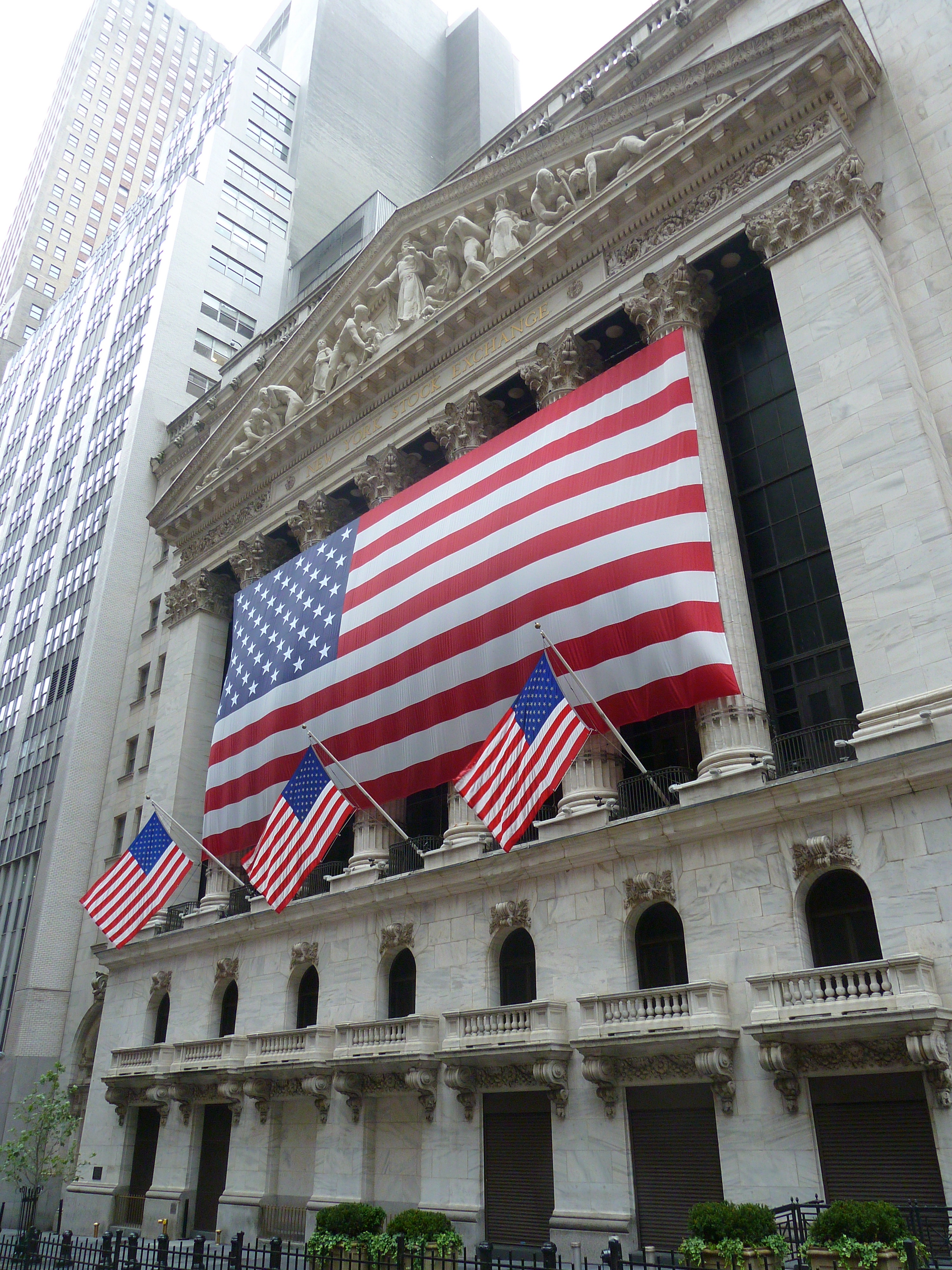
Image: Thursday's drop followed a Wednesday bounce, as investors digested what midterm results could mean for AI infrastructure. — Hundsgemeini via Wikimedia Commons, CC BY-SA 3.0
Why did the reaction hit on Thursday, not election night?
NPR called the Thursday decline a reversal from Wednesday, when investors initially sent shares higher after the midterms did not end with control of Congress left undecided. The later session, NPR said, was investors "coming to terms with the potential consequences": voters revolted against data centers over water and energy, and they supported Democrats who vowed to push back.
That sequence matters for anyone reading the tape. The first move was relief that the map was clear. The second was a repricing of what that map implied for AI campuses.
Which companies are most exposed?
The first-order exposure is anyone whose earnings story still depends on rapid data-center construction and AI capital spending.
- Chipmakers and other AI-infrastructure suppliers. Their demand thesis is customer capex. If interconnection queues lengthen or projects slip from 2028 schedules, the risk shows up in orders, not only in headlines. Closing moves for Nvidia, AMD, and the broader semiconductor index are recorded in the Nov. 5 close piece.
- Large AI platform companies that still need to keep building. NPR noted that many AI companies — including Meta and Alphabet — need additional data centers to keep developing the technology. A slower U.S. siting path is an execution risk even for firms that can spend through higher costs.
- Names investors treated as politically sensitive. NPR said Tesla and SpaceX, both controlled by Elon Musk, were among Thursday's sharp decliners, and that investors feared Musk and his companies could face added Democratic scrutiny after he spent heavily in an unsuccessful effort to elect more Republicans. That is NPR's account of market psychology, not a finding that any investigation or penalty has been announced.
- The other side of a squeeze: firms that already have capacity. If new supply is harder to build, existing megawatts become more scarce. That is a logical split inside the sector; it is not, by itself, a reason to assume every large-cap tech name is equally exposed.
Utility bills sit underneath all of this. If developers are pushed to pay the full cost of power and grid upgrades — the bargain OpenAI sketched after the election — that can protect households and still raise the cost of compute. Investors can dislike both a delayed site and a more expensive one.

Image: NPR and POLITICO both described investor concern that a new Congress could add AI rules on top of local and state siting fights. — Jeff Kubina via Wikimedia Commons, CC BY-SA 2.0
What is not priced as a done deal?
Axios reported that most U.S. data centers expected in 2027 are already under construction, so a political shock lands hardest on later years. A six-month-plus hold in Texas, it said, would extend delays in the state that SemiAnalysis ties to 41% of 2028 additions. That is a timing argument: 2028 pipelines are more exposed than work already in the ground.
Axios also said most political analysts it cited do not expect Democrats to block construction permanently. Markets can punish delay and uncertainty without forecasting a national moratorium.
NPR added a household wrinkle: AI has been a driver of recent U.S. growth — it cited 3.4% annual growth in the July–September quarter — and ordinary retirement accounts hold these stocks, so a long AI selloff would not stay inside specialist portfolios.
What to watch next
- Statehouses, especially Texas through mid-2027. Watch whether campaign moratorium language becomes legislation, and whether projects already under construction are carved out.
- Local implementation of the 40 measures that favored limits. A ban, a six-month freeze, a rezoning defeat, and an advisory vote are not the same constraint.
- Utility commissions and "who pays for the grid" cases. Cost-shifting rules can slow projects even where zoning remains open.
- The new Congress after it is seated in January. The risk NPR and POLITICO described is future rulemaking, not a law that already passed last week.
- Whether companies change siting, not only messaging. OpenAI's compact is one corporate response; the test is partner-owned sites, audits, and what happens when a community still says no.
Conclusion
The Nov. 5 AI-stock drop was a repricing of political and physical bottlenecks — local ballots, state permitting, possible federal rules, and higher power costs — around the data centers the industry still needs. It was not only a bad tape for chips.
Takeaway: Follow the permitting calendar and the 2028 capacity map, not just the index close; delay and higher grid costs can hit earnings even if no nationwide ban ever appears.
Sources
- ‘Total bloodbath’: Democrats' sweeping wins rock Wall Street over AI fears — POLITICO
- Fears of an AI crackdown after midterms spark $2 trillion rout in tech stocks — NPR
- Voters deliver "AI earthquake," rebuking tech and billionaires — Axios
By W. Soares
Educational content only. Nothing here is investment advice.


